Delay Relay is an AI product that can help you predict flight
delays. Using machine learning and data from your flight, Delay
Relay is able to detect delays that may occur. We are dedicated to
keeping you updated and saving your time.
The goal of this project is to predict whether or not a flight will be delayed based on variables such as airline, airport, weather, and square footage of the airport. This problem is a classification problem, as there are only two possible outcomes: a flight will be delayed, or a flight will not be delayed.
Delay Relay is an AI product created to keep you flying on time and aware. After thorough research, we realized that people struggle with staying updated on flight delays. Because of this, we created a product for people to stay informed and fly smoothly!
To make sure that our model would work accurately, we needed to clean the data and make sure that it would fit our model. We removed rows and columns that were unneeded or unfinished, such as Aberdeen. Aberdeen Airport had only two recorded flights, which would possibly screw up our data, so we tossed it out.
Extra, extra!
Additionally, our team took into account airport size and weather since we believed that these factors played a major role in a flight's delay status. Since this data wasn’t in the original dataset, we added it in manually.
Merge!
Next, we took our newly inputted data and original, cleaned dataset and put them together. We did this with the help of the Python library pandas.
Encoding
Before fitting our model, we had to change some of the categorical variables in our dataset (ex: AirportFrom, Airline) to numbers. This makes the data readable when training models.
Machine Learning!
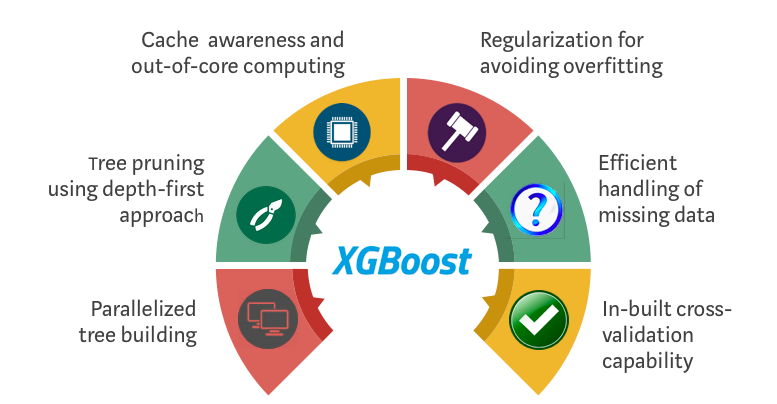
We've used a total of three machine learning models (XGBoost, SVM, and Random Forest) to put our data into. Since we're trying to determine whether a flight will be delayed or not, this counts as a classification machine learning problem. This is because there are only two possibilities, the flight will be delayed, or it won't.
SVM
SVM is a model that tries to find a hyperplane that distinctly classifies the data
XGBoost
XGboost is a model that implements gradient boosted decision trees to classify the data
Random Forest
Random Forest is a model that utilizes classic decision trees to make predictions
SVM
Accuracy: 66.7% Runtime: 480 minutes
The orange line represents the hyperplane that separates the data into two classes.
XGBoost
Accuracy: 66.4% Runtime: 16.2 seconds
Random Forest
Accuracy: 61.5% Runtime: 123 minutes
Visualizations
In order to find correlations between different variables in our data, we used Python libraries, such as Seaborn and Plotly, to help us visualize and analyze these relationships. You can click on each image to get a visualization.
Airport of Departure
AirportFrom
Airline
Airline flown
Square Footage
Sq. Ft of Runways
Weather
Weather at each airport
Day of Week
DayOfWeek
Flight Duration
Length
Airport of Departure
This histogram shows the percentage of delays at each airport of departure (AirportFrom).
The three airports of departure that have the highest percentages of delays (from highest to lowest) are MDW (Chicago Midway), DAL (Dallas Love), and OAK (Metropolitan Oakland International). This could be due to the fact that all three of these airports are in or near major cities. MDW and DAL are located in the cities in which they are named, while OAK is located near San Francisco (Oakland is near San Fransisco Bay Area). Chicago, Dallas, and San Francisco have populations of over a million.
The three airports with the lowest percentages (from highest to lowest) are HTS (Tri-State Walker-Long), FLG (Flagstaff Pulliam), and TXK (Texarkana Regional-Webb). HTS is located in Huntington, West Virginia, FLG is located in Flagstaff, Arizona, and TXK is located in Texarkana, Arkansas. All three cities have populations below 75,000.
This evidence suggests that the higher rates of flight delays in larger cities could be caused by their larger populations. Additionally, these cities tend to have higher traffic, which could contribute to a higher demand for flights and therefore a higher rate of delays in the city. The same reasoning can be applied to cities with smaller populations; the smaller population sizes may be the cause of lower flight delay rates.
Airline
This histogram shows the percentage of delays of each airline.
The visual above shows that the airline with the highest rate of delays is WN (Southwest Airlines). The airline with the lowest rate of delays is YV (Mesa Airlines).
Not every airline is displayed here, but it still shows some of the most flown airlines. As we can see here, Mesa Airlines is the most likely to fly without a hitch, while all potential Southwest passengers should be aware of a high probability of delay.
Square Footage of Runways
292 US airports (represented by circles) are plotted on the map below. The map demonstrates the relationships between the airports' geographic locations, the square footages of the airports' runways, and the likelihood of delays.
The 292 airports from our dataset are mapped out according to latitude and longitude coordinates scattered throughout the United States and its territories. The legend to the side has the delay in percentages from 0-70 percent. The majority of the delays can be attributed to airports being in high traffic areas like cities or busy hubs making up a connectome. Guam and Puerto Rico also demonstrate some of these details in reverse. This is because they are island nations and usually have less traffic and airport management in their wake.
The size values based on the square footage of the airport’s runway. We did this in hopes that the size of an airport would show a correlation to delay amount. The larger circles represent much larger airports, while the converse is true for the smaller airports. Smaller airports in more isolated areas or those that see more traffic have higher delay values than their more well-managed counterparts. Meanwhile, larger airports in major cities also see amplified delay amounts that correlate to their high traffic. Surrounding population plays a big role in addition to the size of the airport and runways.
Weather
292 US airports (represented by circles) are plotted on the map below. The map demonstrates the relationships between the airports' geographic locations, the weather at each airport, and the likelihood of delays.
The temperatures are represented on this map using a gradient from 0 to 110 degrees Fahrenheit. These temperatures were taken for every airport during their summer months and later averaged before being visualized. We picked the summer season because that is when flights are most common. Students are out during the summer and are often flying around the world to travel. On the map, we can see that airports closer to the equator tend to be hotter. The southern airports can be extremely hot, whereas airports that are closer to the coast have more temperate and cooler temperatures. This is also seen as you move north and eventually towards Alaska. In particular, many airports lining the West Coast and southern Midwest are reaching sweltering temperatures.
Day of Week
This bar graph demonstrates the relationship between the day of the week a flight takes place on and the percentage of delay. Day 1 in this graph would be considered Monday.
The bar graph above demonstrates that the average rates of delay for the days of the week are relatively similar. The rate of delay for each day of the week lies between 40-50%. Although the rates are very similar, it can be seen that Wednesday has the highest rate of delays at 47%, followed closely by Monday, which has a 46% rate of delay. Given that Day 1 is Monday, Saturday (Day 6) has the least chance of having a delay, if only slightly lower.
Flight Duration
This scatter plot reflects the relationship between the duration of a flight in minutes (Length) and the amount of delays.
From the scatter plot, it is evident that the data is skewed right. Flights with durations ranging from a half hour to 6 hours tend to be delayed more often. A long-haul flight, such as a 9-hour flight, is less likely to be delayed. The highest rates of delay are about an hour to two hour lengths. And for those of you wondering: yes, having a higher number on the left side means skewed right for some reason.
Conclusion: Our Findings
Here's what we found...
Our model came away with 66% accuracy, using XGBoost and GridSearch. However, this took a while to compute, as our data is rather complex. Some may wonder, why is our accuracy so low compared to other models? Most of our data is not directly impacting the outcome of delay, meaning that it makes it harder for the model to predict if the delay will occur or not. During training, we found a relationship between the runway size and the number of delays, as well as the size of the surrounding population. In conclusion, our model is mostly accurate, but may output a few false negatives and positives.
Conclusion: Extensions
Here's what we found...
For our program to function with maximum accuracy, we employed the use of API’s, or application programming interfaces, in order to make our lives easier when it came to finding useful data. We used API’s to add more information relevant to our program, such as weather in real time to make our predictions on delays more precise. Although API’s have been helpful, we have had issues with useless data and data that needed to be scraped which would have taken too much time to complete for what it was worth, not to mention data can be difficult to find.